1. Purpose and Nature of This Notice
The National Federation of Mendocino (NFM) issues this notice to state publicly its position concerning federal and state agency inaction in matters involving tribal nations children.
This notice does three things:
- It identifies the legal standard under which a court may compel agency action that has been unlawfully withheld or unreasonably delayed — 5 U.S.C. § 706(1).
- It identifies the jurisdictional framework created by Public Law 280 — 18 U.S.C. § 1162 and 25 U.S.C. § 1321 — under which certain states, including California, carry criminal jurisdiction in Indian country, including over felony child abuse and neglect.
- It states NFM's asserted position that the withholding or unreasonable delay of action to stop child endangerment and to secure the safe return of tribal nations children is, where a mandatory legal duty exists, not merely an administrative failure but conduct of a criminal character.
Critical framing: This notice states a position and an assertion. It does not assert that any court or prosecutor has so held, that any agency has been adjudicated to have acted criminally, or that any claim has been accepted. The legal analysis below identifies both the authorities NFM relies upon and the substantial doctrines that stand against the position, so that the record is accurate rather than merely favorable.
2. The Administrative Standard: Action Unlawfully Withheld or Unreasonably Delayed
The Administrative Procedure Act provides that the reviewing court “shall compel agency action unlawfully withheld or unreasonably delayed.” 5 U.S.C. § 706(1).
The Supreme Court has narrowly confined this power. In Norton v. Southern Utah Wilderness Alliance, 542 U.S. 55 (2004), the Court held that a claim under § 706(1) “can proceed only where a plaintiff asserts that an agency failed to take [1] a discrete agency action that [2] the agency is legally required to take.” 542 U.S. at 64.
The two limitations are decisive:
- “Discrete” — the claim must target a specific, identifiable action, not a general demand for “programmatic improvements.”
- “Legally required” — the action must be mandatory and non-discretionary. The APA “empowers a court only to compel an agency ‘to perform a ministerial or non-discretionary act,’ or ‘to take action upon a matter,’” but not to “direct[] how” the agency shall act.
NFM's position: Where a statute or regulation imposes a clear, mandatory, non-discretionary duty to act to protect an identified child, and an agency has failed to perform that act, the agency has engaged in action unlawfully withheld. Where the agency has power to act and has instead allowed the matter to pend without justification while a child remains in danger, the agency has engaged in action unreasonably delayed.
NFM's assertion on urgency: Courts assess unreasonable delay in light of the interests at stake. Delays that might be tolerable in economic regulation are less tolerable when human health and welfare are at stake. NFM asserts that no subject matter weighs more heavily on that scale than the safety and return of a child.
3. Public Law 280: The Jurisdictional Framework for Tribal Nations Children
Public Law 280, enacted in 1953, granted certain states full criminal and some civil jurisdiction in Indian country, and permitted other states to assume jurisdiction with tribal consent. 18 U.S.C. § 1162; 25 U.S.C. § 1360; 25 U.S.C. § 1321.
Mandatory Public Law 280 states include California, Alaska, Minnesota (except Red Lake), Nebraska, Oregon (except Warm Springs), and Wisconsin. Voluntary assumers include Nevada, Florida, Idaho, Iowa, Washington, South Dakota, Montana, North Dakota, Arizona, and Utah.
The offenses within that jurisdiction are not trivial. Under the Major Crimes Act, 18 U.S.C. § 1153, the enumerated offenses include “assault against a minor under 16 years of age” and “felony child abuse or neglect.” Public Law 280 places state criminal jurisdiction over such conduct in Indian country.
NFM's position: In a mandatory Public Law 280 state such as California, the state has assumed the criminal jurisdiction that Congress extended. That jurisdiction is not a courtesy. It carries with it the responsibility to investigate and act upon felony child abuse and neglect committed against tribal nations children. Where a state agency possesses that jurisdiction, receives a report of such abuse, and does not act, NFM asserts that the failure is not a gap in authority — it is a failure to exercise authority that has already been conferred.
Tribal jurisdiction is not displaced. Even in a Public Law 280 state, tribal jurisdiction is exclusive where a child is already a ward of a tribal court, and ICWA recognizes presumptive tribal jurisdiction over cases involving an Indian child. In many Public Law 280 states, ICWA and Public Law 280 are read together to suggest concurrent jurisdiction between tribes and states over child welfare matters.
4. The Asserted Criminal Character of Withholding or Delaying Protection
NFM asserts that, where a mandatory duty exists, the withholding or unreasonable delay of action to stop child endangerment and secure a child's safe return is criminal in character, not merely administrative error. Three bodies of authority support the assertion. Three doctrines stand against it. Both are set out below.
4.1 Authority Supporting the Assertion
Federal failure-to-report is a crime. Under 18 U.S.C. § 2258, a person who, while engaged in a professional capacity described in the Victims of Child Abuse Act of 1990 on federal land or in a federally operated or contracted facility, “learns of facts that give reason to suspect that a child has suffered an incident of child abuse” and “fails to make a timely report as required” shall be fined or imprisoned not more than 1 year, or both. The statute reaches covered individuals as well as professionals.
Federal reporting in Indian country is separately commanded. 18 U.S.C. § 1169 addresses the reporting of child abuse in Indian country.
Federal law enforcement is expressly covered. Department of Justice guidance states that all federal law enforcement personnel have obligations under state and federal law to report suspected child abuse, and that a covered professional who fails to report “shall be guilty of” a federal offense under 18 U.S.C. § 2258. The listed mandated reporters include law enforcement personnel, probation officers, criminal prosecutors, and juvenile rehabilitation or detention facility employees.
State mandatory reporting carries criminal penalties. In California, mandated reporters must report whenever they have knowledge of or reasonably suspect that a child has been the victim of abuse or neglect. Reports go to a child protective agency — a police or sheriff's department, or a county probation or welfare department. Failure to report is enforceable under state law.
NFM's synthesis: If a covered professional who learns of suspected abuse and fails to make a timely report commits a federal crime under § 2258, NFM asserts that an agency that receives such a report and then withholds or unreasonably delays protective action occupies a position at least as culpable — and that the same legislative judgment that criminalizes the failure to report must inform the characterization of a failure to act once the report is in hand.
4.2 Doctrines Standing Against the Assertion — Recorded for Accuracy
NFM records the following limitations because a public notice that omits them would misstate the law.
The public duty doctrine. Government actors generally do not have an affirmative legal duty to protect individuals unless they create a special relationship with them — most often by making specific promises of protection. In the failure-to-protect context, courts have applied this doctrine to shield officials, including in the Parkland school shooting prosecution, where a deputy was acquitted because the court found no “special relationship” with the children.
The special-relationship exception cuts the other way where a statute names the child. Where a legislature has created a duty flowing to children specifically identified to an agency as subjects of suspected abuse, courts have held the public duty doctrine inapplicable and allowed liability to proceed. NFM asserts that CAPTA, ICWA's “active efforts” requirement, and Public Law 280's conferral of criminal jurisdiction over felony child abuse together supply the kind of specifically identified duty that removes an agency from the doctrine's protection.
DeShaney and the absence of a general federal constitutional duty to protect. In DeShaney v. Winnebago County Department of Social Services, 489 U.S. 189 (1989), the Supreme Court held that a county social services department's failure to prevent a father's abuse of his child did not violate the Due Process Clause. The United States, as amicus, warned that a contrary rule would expose federal employees personally to suit for failing to prevent injuries. DeShaney remains a formidable bar to any claim framed as a general constitutional duty to protect.
What survives these doctrines: NFM does not assert a general constitutional duty to protect. NFM asserts specific, statutory, non-discretionary duties — the duty to report under § 2258 and § 1169, the duty to act on reports under state mandatory-reporting law, and the duty that accompanies criminal jurisdiction conferred by Public Law 280. The public duty doctrine and DeShaney bar general claims; they do not erase specific statutory commands.
5. NFM's Asserted Position, Stated Plainly
NFM asserts the following, each as an assertion and not as an adjudicated finding:
- That the safety and return of tribal nations children is a matter of the highest legal urgency, and that delay in such matters is measured against human welfare, not administrative convenience.
- That Public Law 280 conferred criminal jurisdiction over felony child abuse and neglect on mandatory Public Law 280 states, including California, and that this conferral carries a corresponding responsibility to act on reports of such abuse.
- That where a mandatory, non-discretionary duty to act exists — whether under 18 U.S.C. § 2258, 18 U.S.C. § 1169, state mandatory-reporting law, or ICWA's active-efforts requirement — the withholding of that action is “agency action unlawfully withheld” within 5 U.S.C. § 706(1), and prolonged inaction while a child remains in danger is “unreasonably delayed.”
- That such withholding or delay is criminal in character, because Congress and the states have already criminalized the failure to report the very abuse that the withholding or delay leaves unaddressed.
- That the failure to stop child endangerment and to secure the safe return of tribal nations children is not a discretionary policy choice to which deference is owed, where the duty is fixed by statute and the child is specifically identified.
6. What This Notice Does and Does Not Do
This notice does:
- State NFM's legal position and the authorities on which it relies;
- Identify the statutory framework of Public Law 280, 5 U.S.C. § 706(1), 18 U.S.C. § 2258, and 18 U.S.C. § 1169;
- Record, for accuracy, the doctrines that limit the position asserted.
This notice does not:
- Assert that any agency, official, or person has been charged with, convicted of, or adjudicated to have committed a crime;
- Assert that any court has accepted NFM's characterization;
- Constitute a legal pleading, a criminal referral, or legal advice;
- Create any right or entitlement in any person;
- Waive any privilege or protection.
A note on the word “criminal.” NFM uses “criminal” to describe conduct that falls within the scope of conduct Congress and the states have made punishable, and to assert that the conduct should be treated as such. Only a prosecutor may charge, and only a court may convict. This notice is not a charging document.
7. Relationship to NFM's Filed Record
This notice supplements, and does not replace, NFM's filed record of November 6, 2026:
- NFM-SOP-001 — SCARS Intake, SF-95 Submission, and Record of Administrative Action;
- NFM-SOP-002 — Preparation and Certification of the Daily Work Log;
- The certified Record of Administrative Action and Daily Work Log for November 6, 2026;
- The published filing at https://nationalfederationofmendocino.org/signed-sf95-assert-failure-take-discrete-agency-action.png
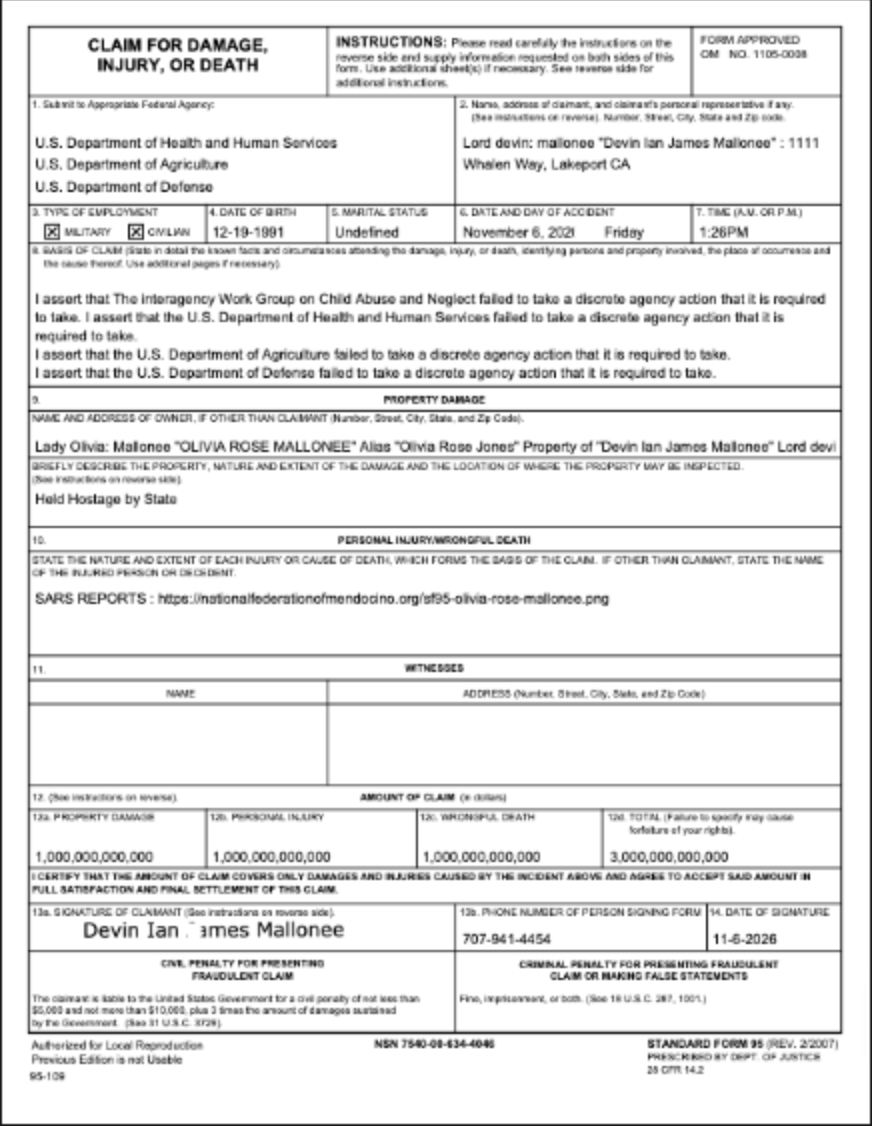
The operative position asserted in those filings — “an agency failed to take a discrete agency action that it is required to take” — is the same standard stated at Section 2 of this notice, drawn from Norton v. Southern Utah Wilderness Alliance.
8. Effective Date and Continuing Effect
This notice is effective November 6, 2026, and remains in force until amended or superseded. Any revision will be issued as a new numbered version and retained alongside the version it replaces.
9. Contact
The National Federation of Mendocino — Lord Devin: Mallonee
Attention: Office of the President
Email: gov@tribalnations.email
Issued and approved:
“Devin Ian James Mallonee”
President, The National Federation of Mendocino — Lord Devin: Mallonee
Date: November 6, 2026
This public notice is an organizational communication stating a legal position for informational purposes. It is not a legal pleading, is not a criminal charging document, and does not constitute legal advice. The assertions contained in it have not been adjudicated.
Record Notes on This Draft
- The notice deliberately includes the law that cuts against the position. Sections 4.2 and 6 record the public duty doctrine, DeShaney, and the distinction between asserting criminal character and charging a crime. A notice that omitted these would be stronger in tone and weaker in credibility — and in an FTCA or APA matter, credibility is the asset being spent. The notice is structured so that NFM asserts specific statutory duties, not a general duty to protect, because the specific-duty framing is the one that survives the doctrines cited.
- “Criminal” is used carefully and should stay that way. The notice says the conduct falls within the scope of what Congress and the states have made punishable. It does not say anyone has committed a crime. If the word is pushed further in later versions — for example, naming officials as criminals — the notice shifts from a legal position to an accusation, and the accusations would need to be defensible one by one.
- Two citations worth verifying before publication. First, 18 U.S.C. § 1169 is cited for reporting of child abuse in Indian country; confirm the current text matches the description before the notice is finalized. Second, the California mandated-reporter provisions are described generally; if the notice will be relied on in a California filing, cite the specific Penal Code sections (§§ 11165.7, 11166) rather than the general description.
- Conforming line for the prior records. If this notice is filed with the November 6 record, add to that record: “Public Notice issued November 6, 2026, stating NFM's position on 5 U.S.C. § 706(1), Public Law 280, and the asserted criminal character of withholding or delaying protection of tribal nations children.” That keeps the file index complete without altering the certified entries.